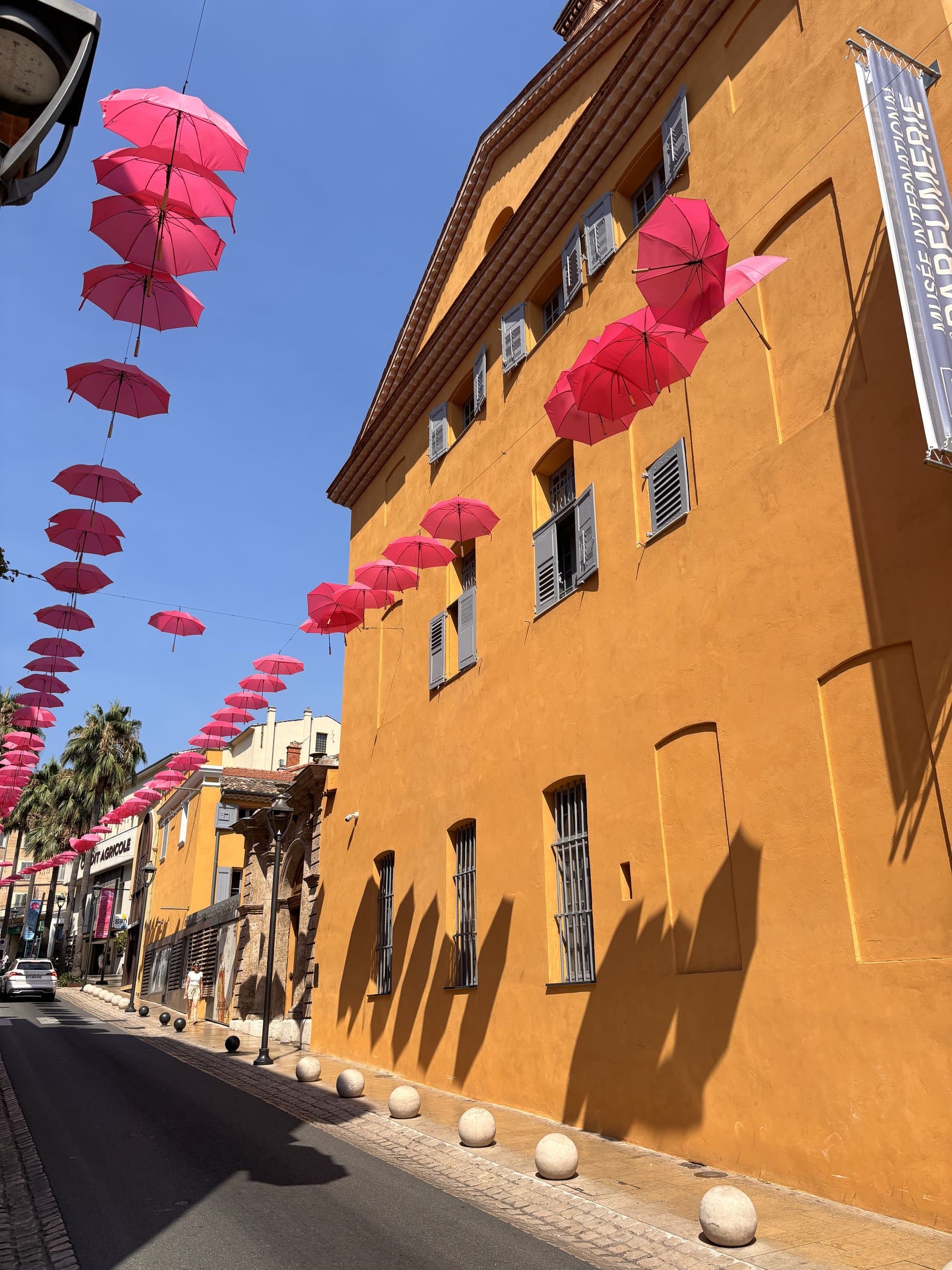
You walk down from the villa through the lanes, pass a couple of perfumery windows, and arrive on boulevard du Jeu de Ballon in front of an ochre façade strung with pink umbrellas suspended above the street. That's the moment to ask a question you might never have thought to ask before coming to Grasse: what exactly is a perfume, and why this town rather than another.
Opened in 1989 and entirely rebuilt in 2008 in a building designed by architect Frédéric Jung, wrapped around a 14th-century rampart and the Hôtel de Pontevès, the International Perfume Museum (known locally as the MIP) isn't a museum of glass cases you walk past in silence. It's a route you smell as much as you look at: it explains how flowers are picked, the tools that turn an armful of jasmine into a few drops of essence, Grasse's particular place in that story, and the role of a trade people think they understand without ever quite having grasped it, that of the "nose."
Picking, tools, the gesture
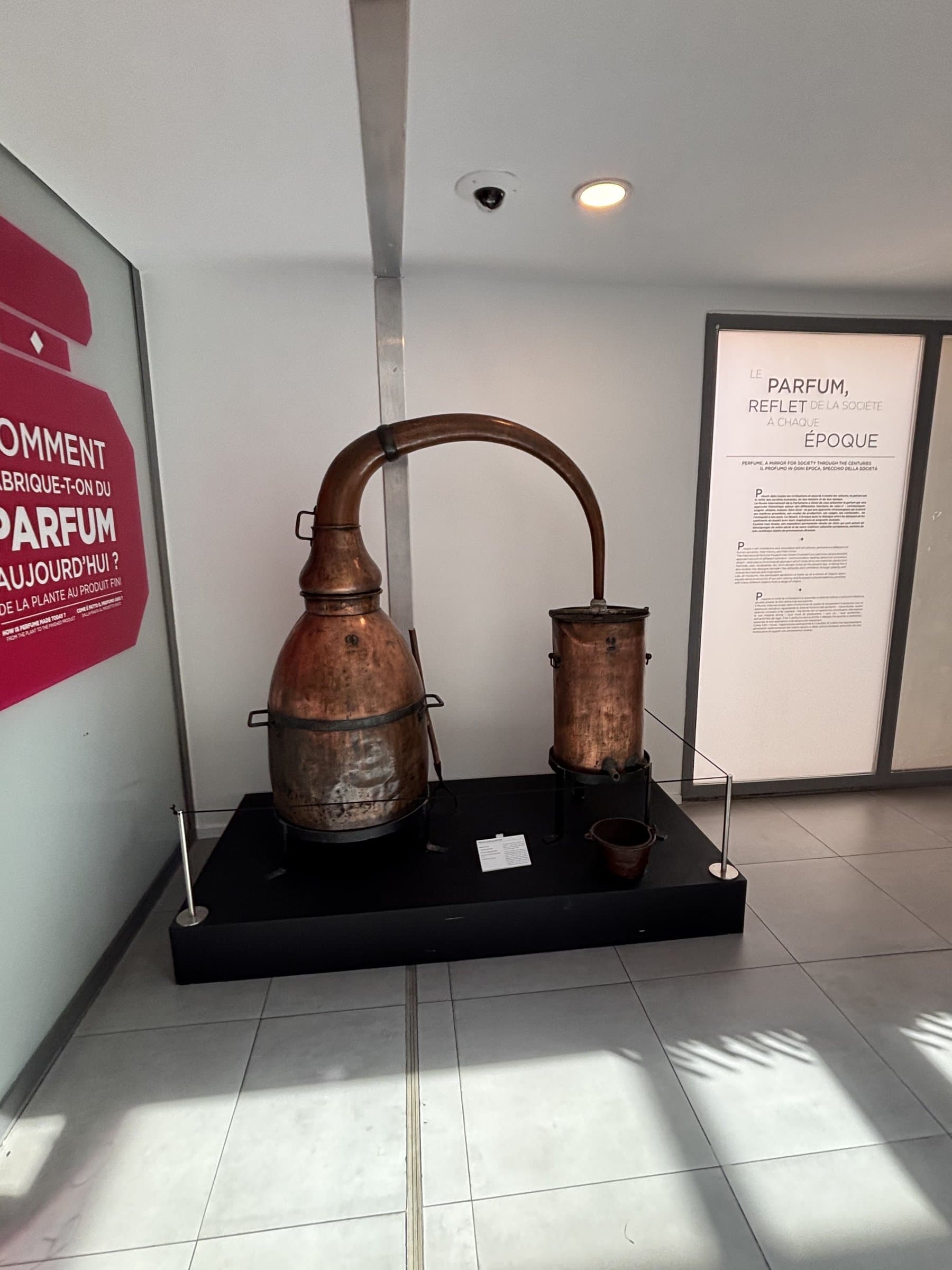
Everything starts in the fields. Rose centifolia is picked in May and June, jasmine from July to October, still at dawn and still by hand, with baskets or large aprons, traditionally by women: each picker gathers close to 10 kilos of roses, or 2 kilos of jasmine, in a single day. The museum then traces how those flowers became raw materials, through tools you can see up close: hand- shaped copper stills, steam distillation, and infusion for the most fragile materials (vanilla, benzoin, oakmoss) in a warm solvent. The large double-bodied still on display in one of the first rooms gives a very physical sense of what making an essence meant in the 19th century: fire, copper, patience.
The nose, part artist, part technician
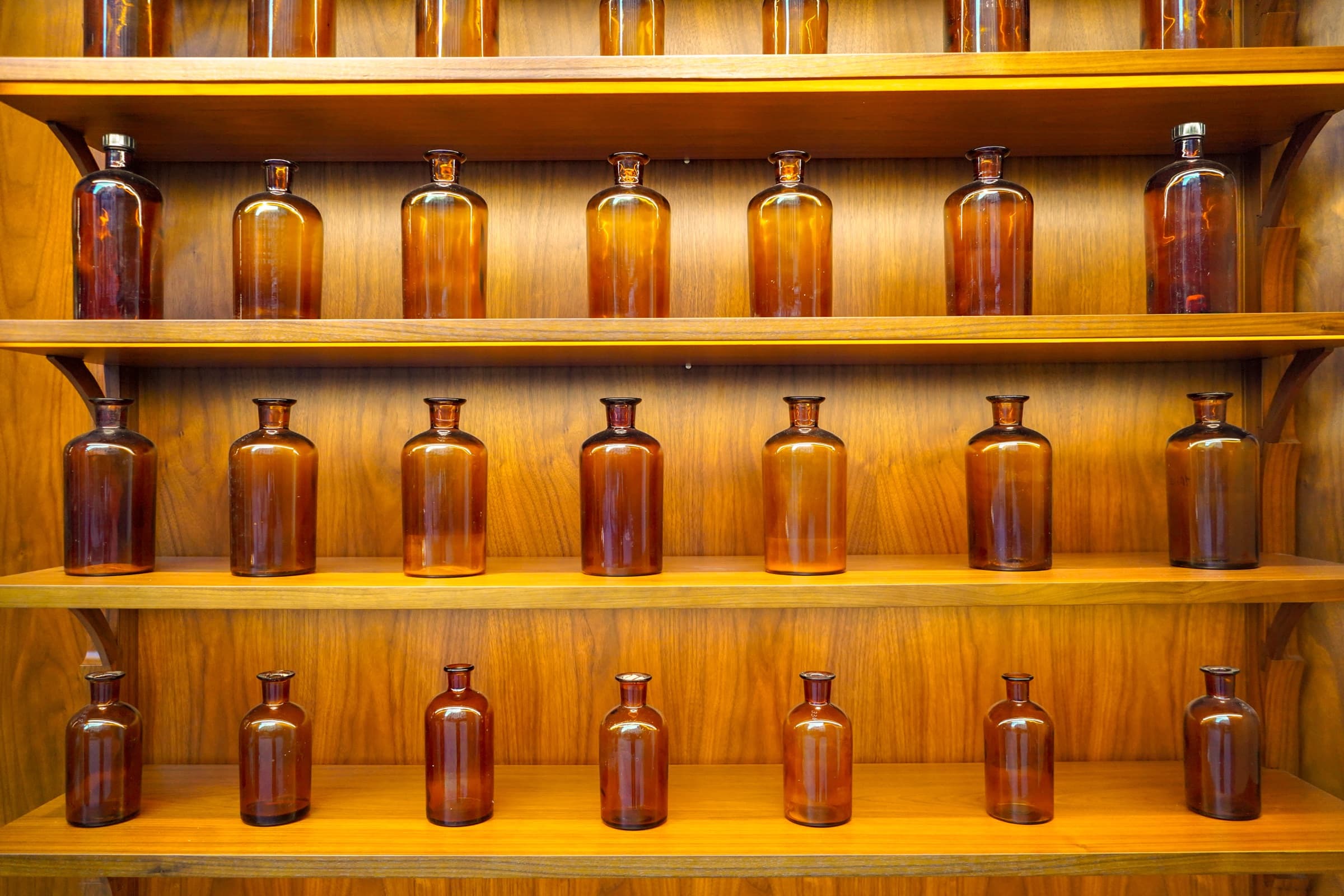
A little further into the route, one room changes register entirely: it's no longer the tool that matters but the person using it. A nose is never quite only an artist or only a technician, but both at once. They know hundreds, sometimes thousands, of raw materials by heart, combine them with a chemist's rigour, and yet compose a fragrance the way someone writes a sentence, with intent, a signature, something that can't be fully taught. It's that double gesture, technical memory and creative instinct held in the same trade, that the museum sets out to show rather than explain: perfume organs, formula notebooks, reference bottles, all traces of work that stays, despite every modern tool, stubbornly human.
A journey through the centuries
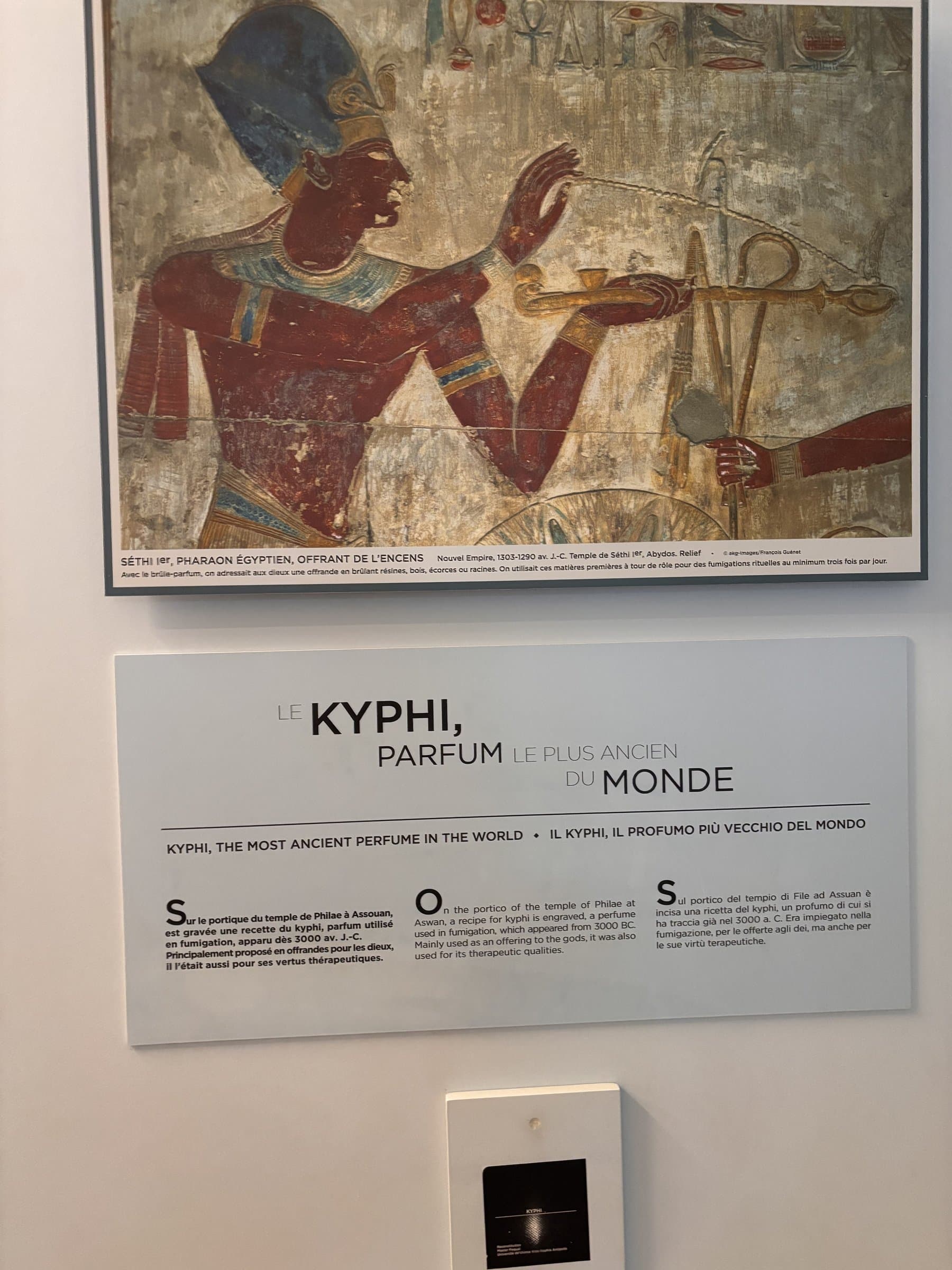
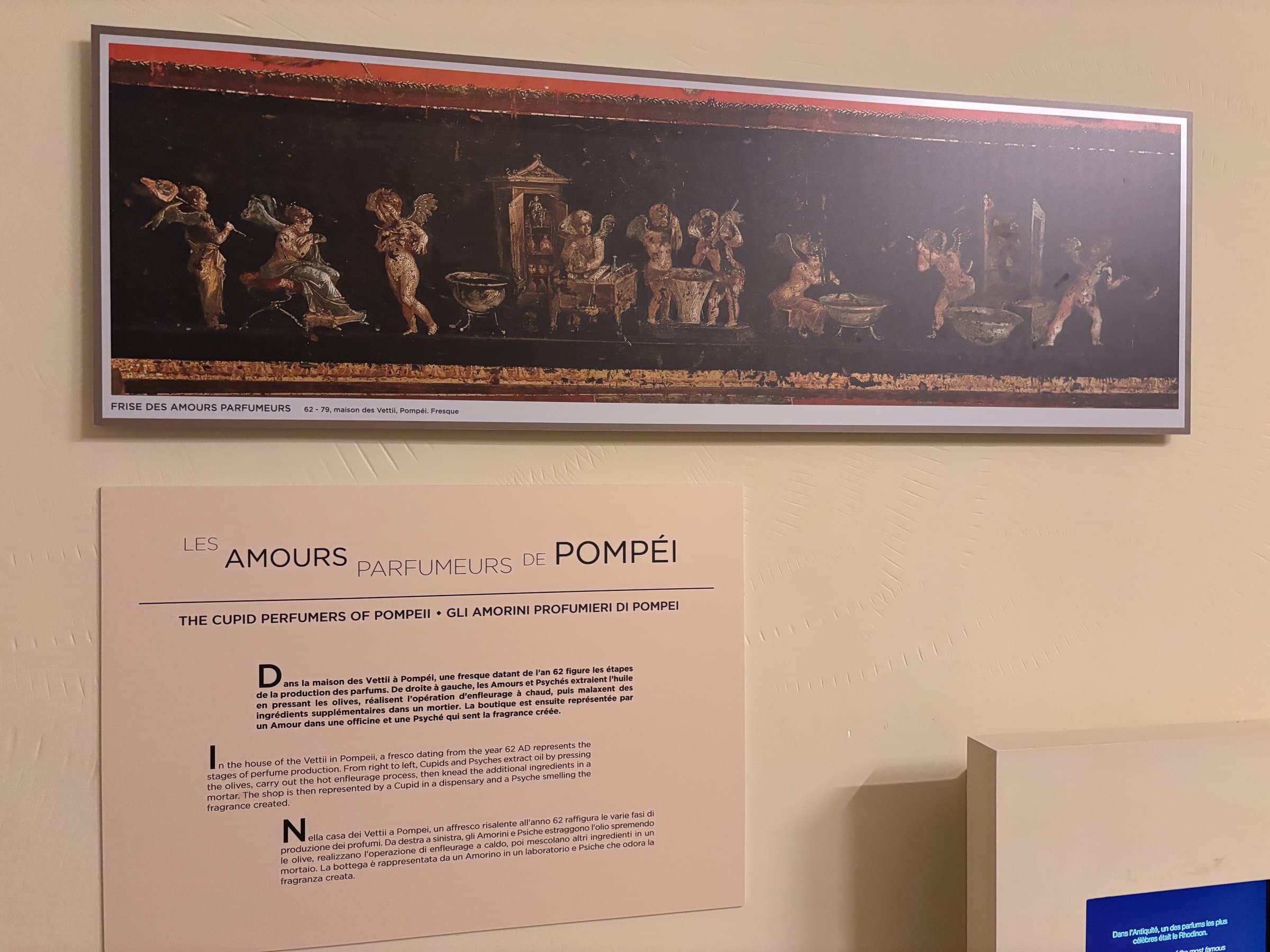
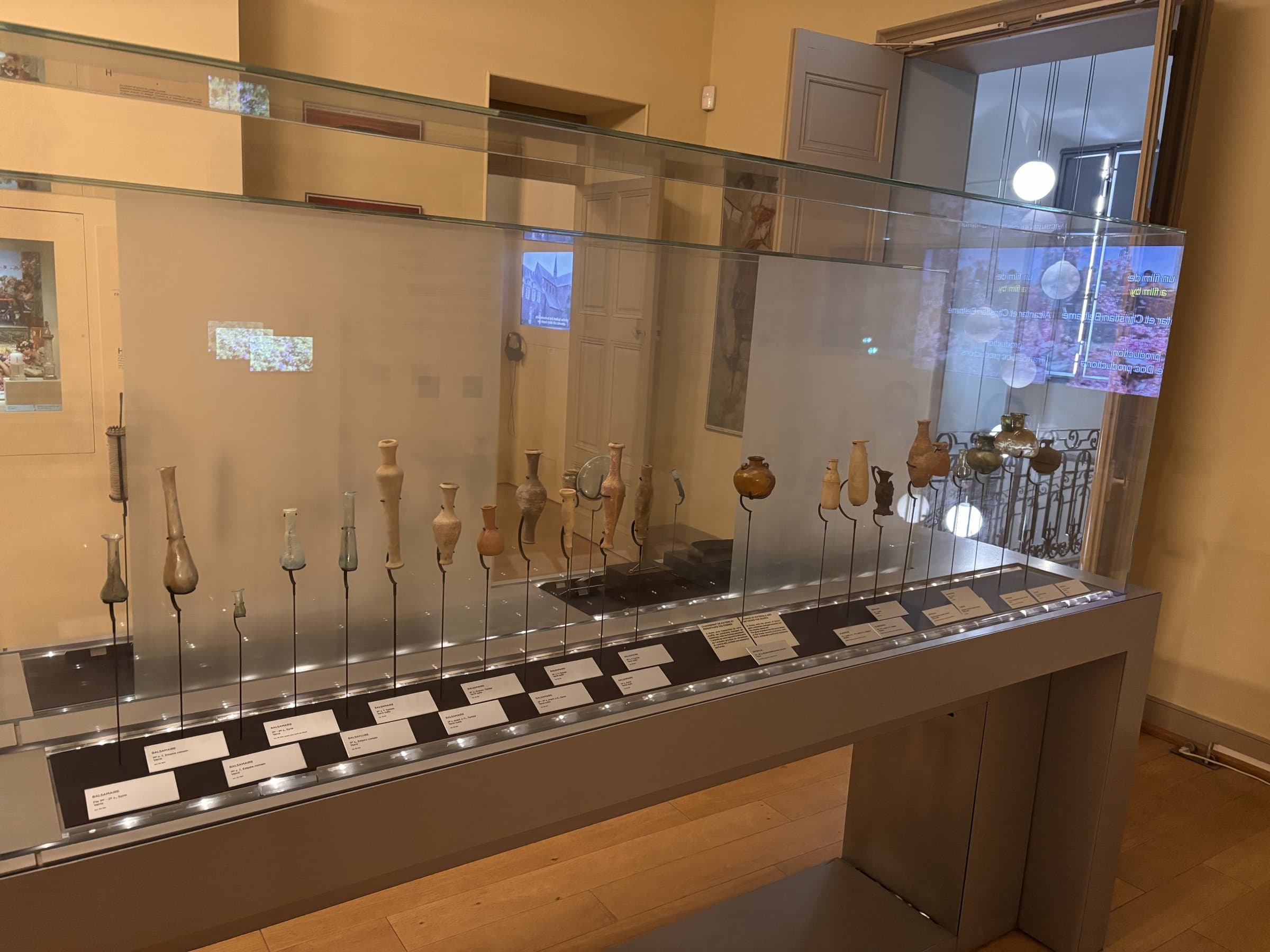
The rest of the museum unrolls a long history, that of perfume itself. It begins in Egypt, the first great user of both religious and everyday perfumes, where priests and the royal court reserved preparations such as kyphi for themselves. It continues in Greece, which multiplied the everyday uses of perfume while keeping its ritual function, then in Rome, where conquest opened access to spices and resins from Arabia, Africa and India, and where blown glass finally made the individual bottle possible. Then come the Middle Ages, then the Renaissance: from the 16th century, with public hygiene in poor shape, perfume was first used to mask odours before becoming, in the 17th and 18th centuries, a genuine tool of seduction, worn on the body as much as on clothing. This is the moment Grasse itself enters the story it would later come to embody: its tanners were already perfuming their hides to mask the smell of leather, and soon began perfuming simply to perfume, a shift in trade that the court fashion for scented gloves, popularised, so the story goes, by Catherine de' Medici, only accelerated. The museum traces how that sideline became, within a few generations, the reason the whole town existed. The following centuries, up to the 20th, close the loop with perfume's entry into popular culture, right through to the poster Warhol made of Chanel No. 5.
History
From Egypt to Rome
Two images that sum up three thousand years of habit: Pharaoh Seti I offering kyphi to the gods, and the small perfume-selling cherubs painted at Pompeii, caught making and selling essences in an almost domestic scene.
Elsewhere in the world
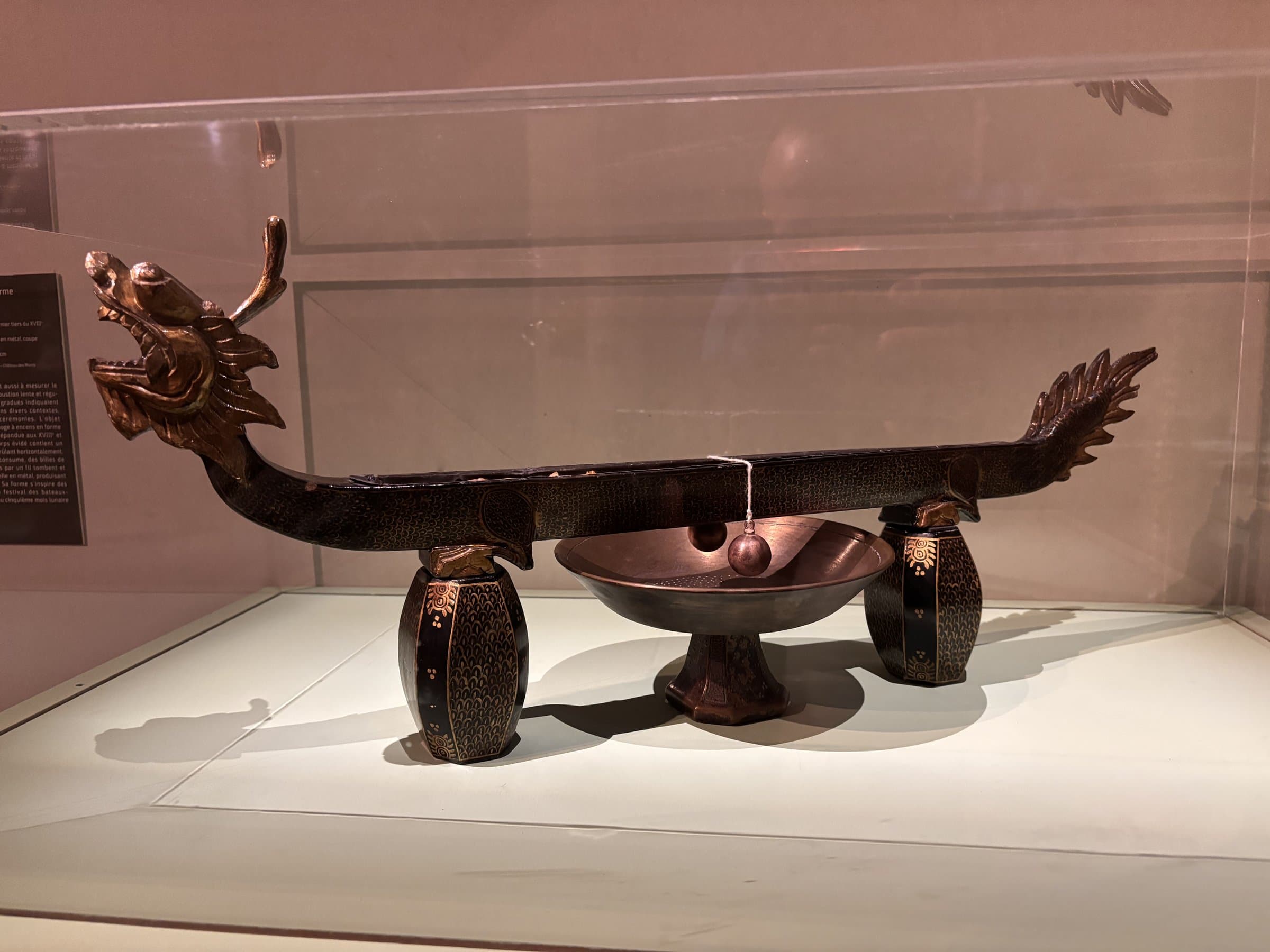
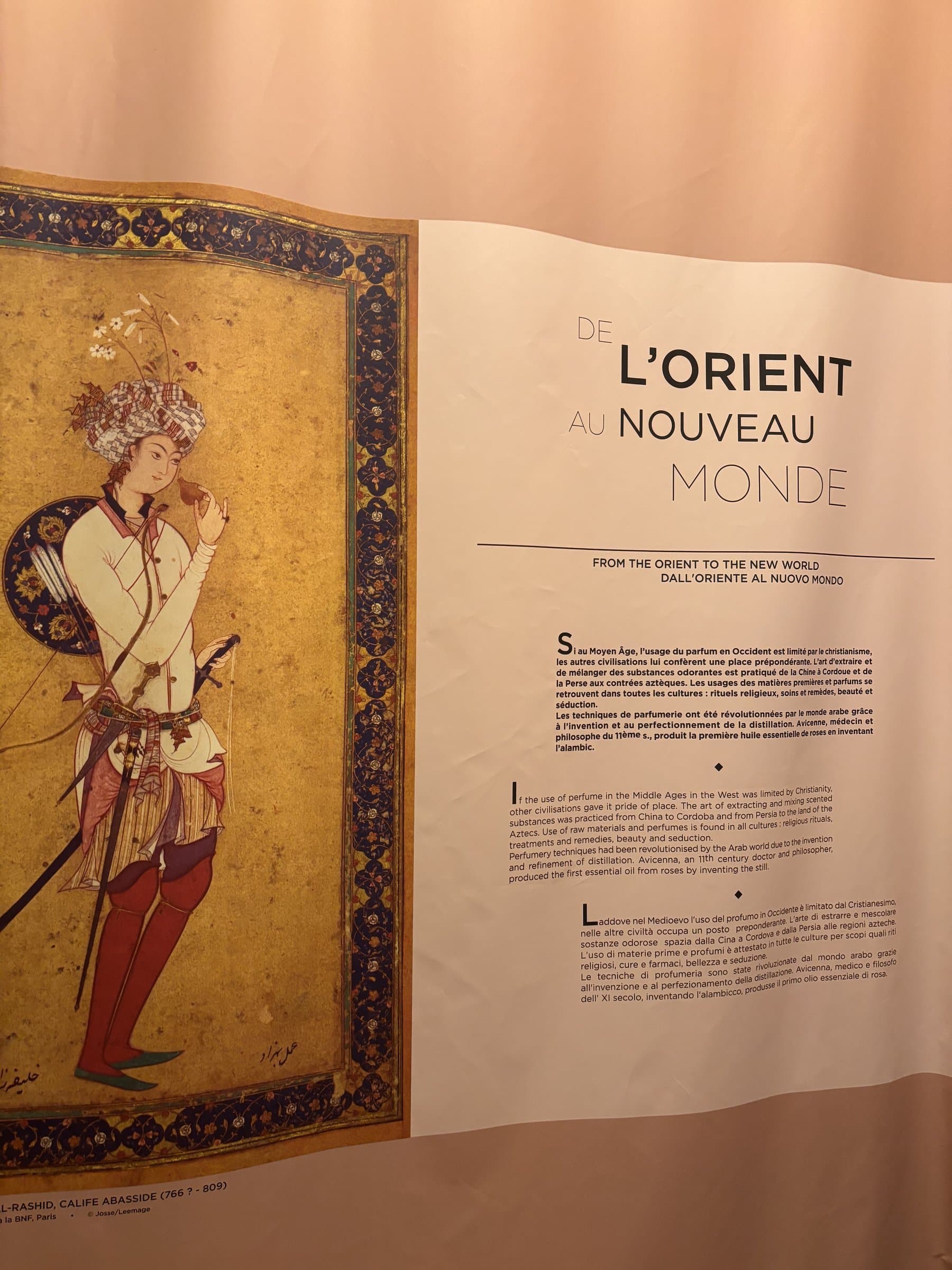
The route doesn't stop at Western history. One whole room is devoted to other ways of scenting the world: a traditional open-flame still, still used in Tunisia into the 1990s, a mix of copper, terracotta and aluminium; a 14th-century Syrian manuscript, the Kashf al-asrar, describing rose picking and the distillation of rosewater; a Persian miniature showing a caliph holding a flower, a reminder that in the East too, perfume was long a matter of court life and refinement as much as religion. These objects, less familiar than the great names of French perfumery, are proof that Grasse invented nothing about the desire to smell good: it turned that desire into a craft, then an industry.
Elsewhere
Other ways of scenting
From Persia to Rome, the same display tells two stories: a court where a flower is offered like a jewel, and the first blown-glass bottles, which made perfume portable, then desirable in its own right.
The garden and the nose's test
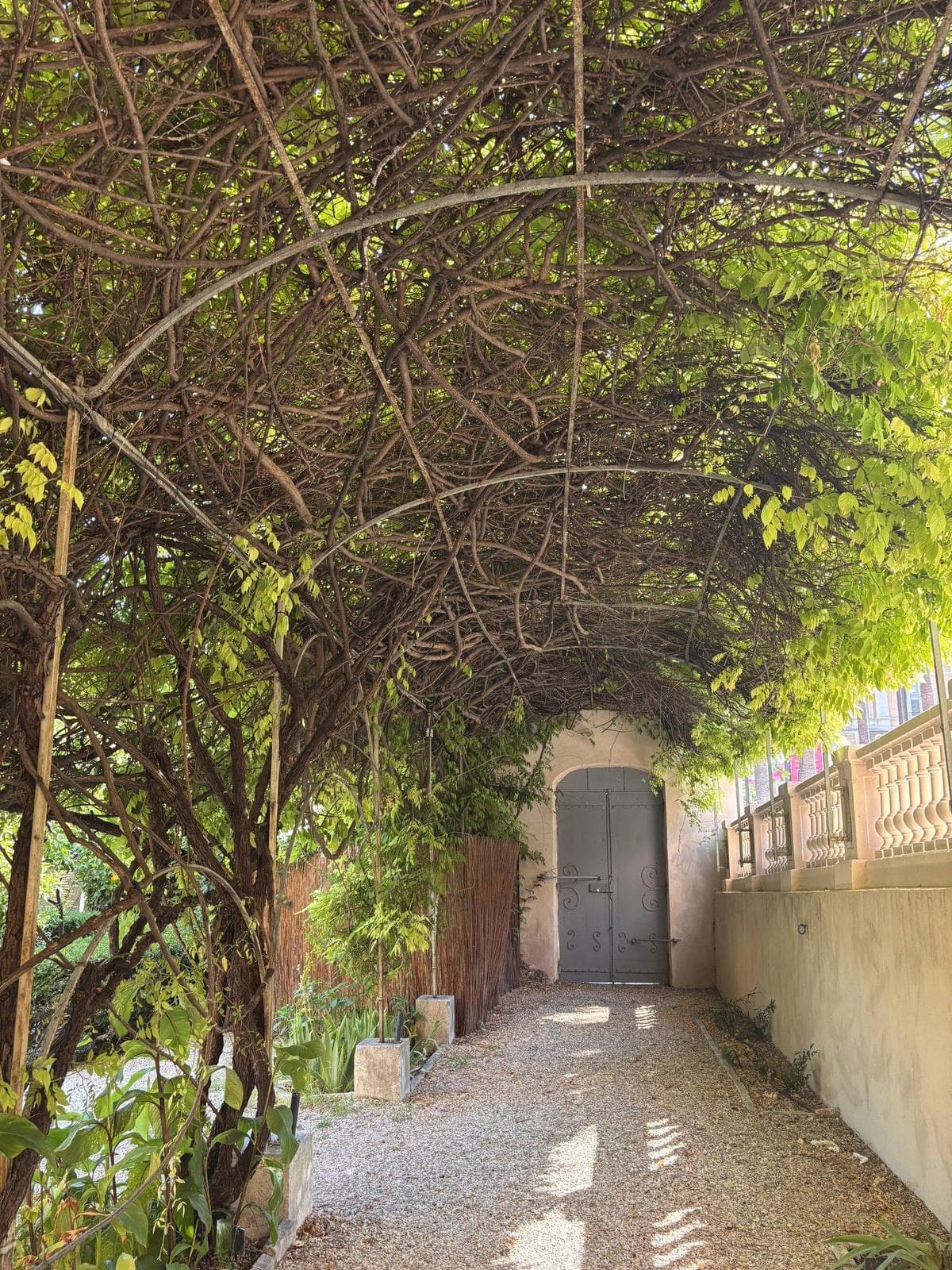
Once you've walked the collection rooms, the museum continues outdoors, in a terraced garden growing most of the plants worked into Grasse's perfumes: rose, jasmine, iris, myrtle, geranium. A greenhouse holds even more species, with a small smelling box in front of each plant, letting you compare the scent of the fresh flower with that of the essence drawn from it, two experiences that are often surprisingly different. It's also where you can test your own ability to recognise scents, through a sequence of extracts offered along the visit: a simple exercise, but one that lastingly changes how you notice a perfume afterwards, on your own skin.
Visiting the museum from the villa
The museum sits right in the centre of Grasse, close enough to the villa to reach on foot through the lanes, a few minutes of easy walking, with no need to take the car. It's a good way to start a morning in the old town, before pressing on to the grand perfume houses or simply wandering the ochre façades. Until 3 January 2027, the museum also runs a temporary exhibition devoted to the perfumes of Asia, one that deserves its own article: read more in this dedicated article. More ideas for outings from the villa are gathered in the Discover hub.
FAQ
Is the museum suitable for children?
Yes, very much so: the route mixes objects to look at, boxes to smell and a garden to explore, which works well for younger visitors and adults alike. Children in particular tend to enjoy the greenhouse and the scent-recognition exercise.
How much time should I allow to visit the Grasse Perfume Museum?
Allow an hour to an hour and a half for the indoor route and the garden, longer if you take your time at each smelling box. Opening hours and prices can change, so check them directly on museesdegrasse.com.
How do I get to the museum from the villa?
On foot: the museum on boulevard du Jeu de Ballon is a few minutes' walk from Villa Apolline, crossing the old town. It's the most pleasant way to go, especially early in the morning.